
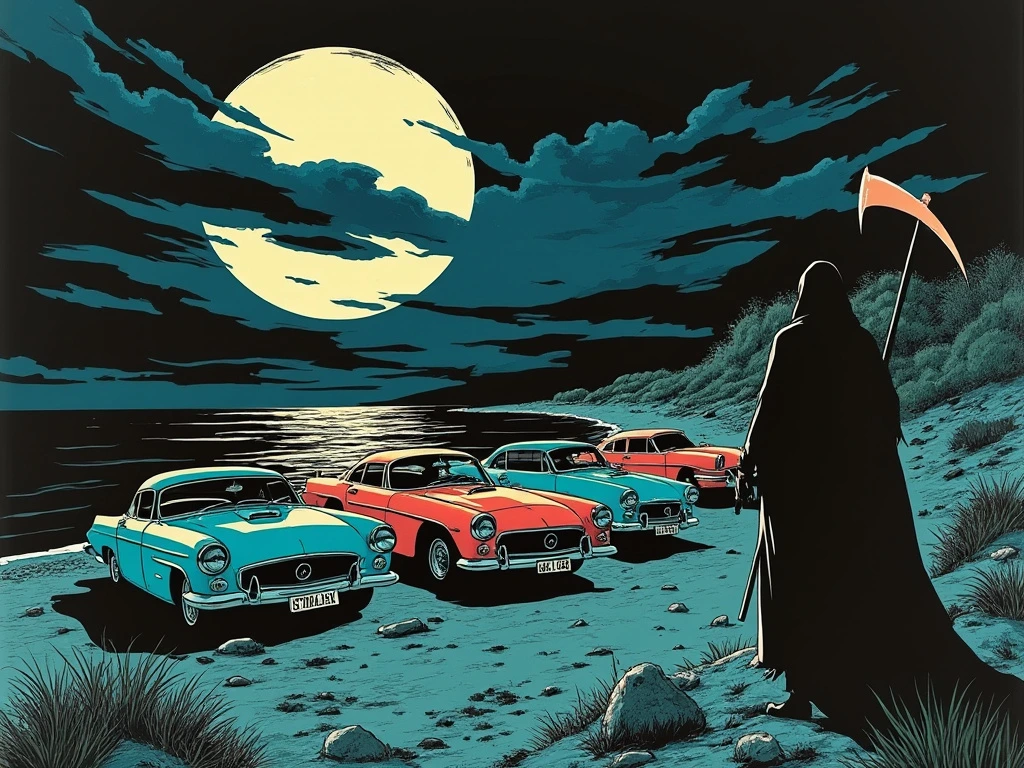
Urban legends weave themselves through the fabric of our collective consciousness like dark threads in an endless tapestry, each story a shadow-stitch in humanity’s grand narrative. In the liminal spaces between truth and fiction, these tales flutter like moths around the porch lights of our imagination, drawing us inevitably closer to the darkness beyond.
The Digital Haunting: Modern Urban Legends in the Age of Light and Silicon
In the phosphorescent glow of our screens, urban legends have found new hunting grounds. Here, in the endless corridors of the internet, Slender Man stalks through pixelated forests, his impossibly tall form a manifestation of our digital-age anxieties. Born in the depths of online forums, this suited specter represents something unprecedented in the history of folklore: a consciously created myth that gained such momentum it began to cast real shadows on our world.
Creepypastas bloom like midnight flowers in the garden of online storytelling, each one seeding new fears in fertile minds. Consider the tale of Jeff the Killer, whose bleached face and carved smile spread across networks like a virus of the imagination. These digital urban legends speak to ancient fears dressed in modern garments – the stranger in the shadows now lurks in lines of code, the monster under the bed now hibernates in hard drives.
The Russian Sleep Experiment, another digital-age urban legend, whispers of Cold War horrors and human depravity, reflecting our contemporary anxieties about government control and scientific ethics. These stories persist because they touch something primal while wearing the mask of modernity.
Geographical Ghosts: Regional Urban Legends of America
Like rings in an ancient tree, urban legends mark the growth of American folklore, each region harboring its own particular phantoms. The Jersey Devil prowls the Pine Barrens of New Jersey, its very existence a challenge to rational thought, yet its legend persists like morning mist in a forgotten valley.
In Maryland’s shadows, the Goatman stalks abandoned railroad tracks, a chimeric fusion of man and beast that speaks to our fears of the wild that still lurks at civilization’s edges. Native American Skinwalker tales whisper across the desert landscapes of the Southwest, where shapeshifters dart between the worlds of spirit and flesh.
Each of these regional urban legends carries the DNA of its birthplace:
- The Jersey Devil reflects the untamed wilderness that once dominated the Eastern seaboard
- Goatman embodies the tension between urban development and natural spaces
- Skinwalkers represent the complex layering of indigenous beliefs with modern fears
Global Whispers: International Urban Legends
Across borders and oceans, urban legends speak in different tongues but tell the same human stories. La Llorona’s weeping echoes through Mexican nights, her tragic tale of love and loss resonating with universal themes of motherhood and redemption. The Banshee’s keening cuts through Irish mists, her presence a harbinger of death that speaks to our eternal struggle with mortality.
In Japan, the Kuchisake-onna (Slit-Mouthed Woman) stalks modern streets with ancient questions: “Am I beautiful?” Her story, like many urban legends, adapts to contemporary fears while maintaining its traditional heart. Consider how these international urban legends mirror each other:
The weeping woman archetype appears across cultures:
- La Llorona in Latin America
- The White Lady in various European traditions
- Pontianak in Southeast Asian lore
Each carries the weight of feminine tragedy, societal expectations, and the price of transgression against social norms.
The Mirror’s Edge: Urban Legends vs. Reality
Where does shadow end and substance begin? Urban legends often dance on the knife-edge between fact and fiction. The ritual of Bloody Mary, that midnight game of courage and mirrors, reflects our fascination with the thin veil between worlds. Black-Eyed Children knock on car windows and doorways, their stories spreading through social media like digital wildfire, each retelling adding another layer to their mysterious origins.
Consider these intersections of legend and reality:
- The Bunny Man Bridge in Virginia spawned from real events that morphed into supernatural tales
- Cropsey in Staten Island emerged from actual crimes that became mythologized
- The Mothman prophecies blended genuine tragedy with paranormal speculation
Cultural Echoes: Legends in the Popular Imagination
Like water wearing away stone, urban legends have carved deep channels in our cultural landscape. Hollywood draws endlessly from this well of modern mythology, transforming whispered tales into visual spectacle. Video games create interactive nightmares from these stories, allowing players to step into the shadows themselves.
The influence of urban legends on media manifests in multiple ways:
- Direct adaptations (Candyman, The Ring)
- Inspired works (Stranger Things, American Horror Story)
- Meta-commentary (Scary Stories to Tell in the Dark)
These stories persist because they speak to eternal truths about human nature:
- Our fear of the unknown
- Our need to make sense of tragedy
- Our desire to test boundaries
- Our compulsion to share cautionary tales
The Psychology of Urban Legends: Why We Believe
In the labyrinth of human psychology, urban legends serve as guides to our deepest fears and strongest beliefs. They persist because they perform crucial social functions:
- Warning tales for modern dangers
- Tools for processing collective trauma
- Methods of social bonding
- Ways to explain the unexplainable
Like dreams that wake us in the night, urban legends reveal the shadows in our collective unconscious. They are the stories we tell to make sense of a world that often defies understanding.
The Future of Fear: Evolution of Legends & Creepypasta
As technology advances and society evolves, urban legends adapt like living organisms. New fears breed new stories: tales of haunted algorithms, cursed social media profiles, and artificial intelligence gone rogue. Yet beneath these modern trappings, the same ancient fears pulse like a heartbeat in the dark:
- Fear of the unknown
- Fear of losing control
- Fear of corruption
- Fear of isolation
Conclusion: The Eternal Whisper
Urban legends persist because they are more than just stories – they are the shadows we cast on the wall of human experience. In their telling and retelling, they evolve, adapt, and speak to each new generation in voices both ancient and new. As we stand in the gathering dark of the digital age, these tales continue to whisper their truths, their warnings, and their wisdom.
They remind us that despite our smartphones and satellite maps, despite our science and certainty, there are still places in the human heart where monsters dwell and mysteries dance. In the end, urban legends are mirrors – not of the supernatural, but of ourselves, reflecting back our fears, our hopes, and our eternal quest to understand the darkness that lies beyond the light of reason.
And perhaps, in that reflection, we find not just fear, but fascination – not just horror, but hope. For in our ability to face these shadows and still tell their tales, we prove our courage, our creativity, and our undying human spirit.